
The 2026 Backdoor Roth IRA Master Guide: How to Maximize Tax-Free Wealth as a High Earner
Exceed the 2026 Roth IRA income limits? Learn the step-by-step Backdoor Roth strategy to fund your tax-free retirement. Avoid the Pro-Rata rule and save $7,500+.
Tram Le, CPA
3/9/20263 min read
Introduction: Why the "Front Door" to the Roth IRA is Closed
In 2026, the Roth IRA remains the holy grail of retirement accounts. With its promise of tax-free growth and tax-free withdrawals, it is a cornerstone of any tax-efficient wealth strategy. However, the IRS maintains a strict "bouncer" at the front door.
For the 2026 tax year, the income phase-out limits have been adjusted for inflation:
Single Filers: You begin to lose eligibility at $153,000 of Modified Adjusted Gross Income (MAGI) and are completely barred at $168,000.
Married Filing Jointly: The phase-out begins at $242,000 and ends at $252,000.
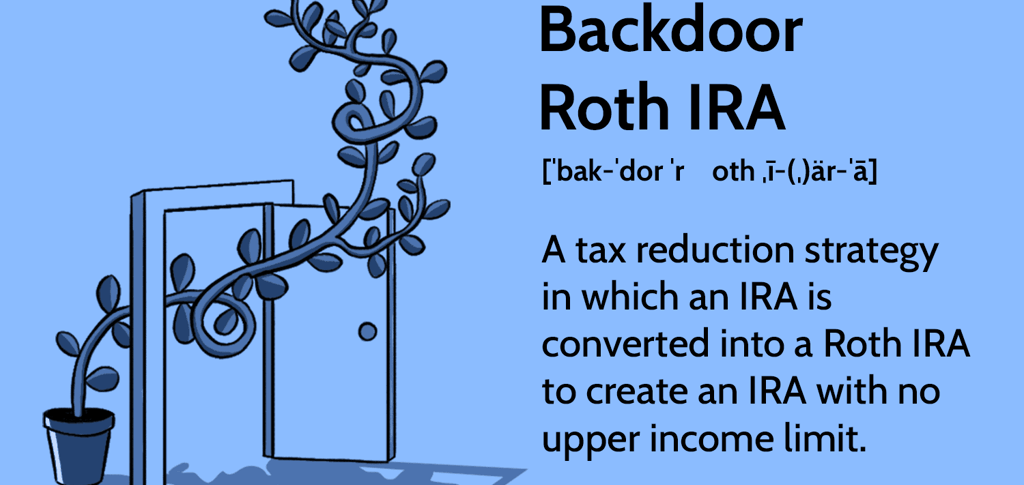
If you earn more than these amounts, you cannot contribute directly to a Roth IRA. But you aren't stuck. By using a two-step maneuver known as the Backdoor Roth IRA, you can bypass these income limits legally.
Step 1: The Non-Deductible Contribution
The first step is to open a Traditional IRA. Unlike the Roth IRA, the Traditional IRA has no income limits for contributing. Anyone with earned income can put money into a Traditional IRA.
However, because your income is high, you will not get a tax deduction for this contribution. This is a crucial distinction: you are making a non-deductible contribution.
2026 Contribution Limits: $7,500 for those under age 50; $8,600 for those age 50 and older (including the $1,100 catch-up).
The Funding: Transfer the cash from your brokerage or bank account into the Traditional IRA.
Step 2: The Settlement and "Step Transaction" Debate
Once the money is in your Traditional IRA, you must wait for it to "settle." Most modern brokerages like Fidelity, Vanguard, or Schwab require 24 to 48 hours.
The Strategy Note: In previous years, tax pros debated the "Step Transaction Doctrine"—the idea that if you do Step A and Step B too quickly, the IRS might view them as a single, illegal act. However, since the Tax Cuts and Jobs Act (TCJA) and various IRS clarifications, the "Backdoor Roth" has been implicitly blessed. Most experts in 2026 recommend converting as soon as the funds settle to avoid any market gains (which would be taxable upon conversion).
Step 3: The Conversion
Once the funds are settled, you initiate a Roth Conversion. This is a simple button-click in most brokerage portals. You are telling the brokerage to move your $7,500 from the Traditional IRA to your Roth IRA.
Because you didn't take a tax deduction on the way in (Step 1), you don't owe taxes on the way out (Step 3)—provided you have no other IRA balances.
The "Pro-Rata Rule": The Billion-Dollar Trap
This is the single most important section of this guide. If you ignore this, you could face an unexpected tax bill in the thousands.
The IRS does not look at your IRAs as individual accounts; it looks at them as one giant "bucket." This is called the Aggregation Rule. If you have a $92,500 Rollover IRA from a previous job and you add a $7,500 "Backdoor" contribution, the IRS sees a total of $100,000.
In their eyes:
$92,500 is "Pre-Tax" (never been taxed).
$7,500 is "Basis" (already been taxed).
Your account is 92.5% taxable.
If you convert $7,500, the IRS mandates that 92.5% of that conversion is taxable income. You cannot "choose" to only convert the after-tax portion.
How to Fix the Pro-Rata Trap: The Reverse Rollover
If you have a large pre-tax IRA, you should perform a Reverse Rollover. Move your pre-tax IRA money into your current employer's 401(k) or 403(b). The IRS Pro-Rata rule only counts IRA balances—it does not look at 401(k) balances. Once your IRAs are at zero, your Backdoor Roth becomes a "clean," tax-free transaction.
Reporting to the IRS: Form 8606
If you don't file Form 8606, the IRS will assume your $7,500 contribution was pre-tax and try to tax you on the conversion.
Part I: Tracks your "Basis" (the $7,500 you put in).
Part II: Tracks the "Conversion" (the move to the Roth).
Make sure your tax preparer knows you did a Backdoor Roth so they don't accidentally report it as a taxable event.
Conclusion: Why It’s Worth the Hassle
The Backdoor Roth is more than just a $7,500 contribution. Over 20 or 30 years, that money—growing entirely tax-free and shielded from Required Minimum Distributions (RMDs)—can represent hundreds of thousands of dollars in extra wealth.
In a world of rising tax rates, "tax diversification" is your best defense. The Backdoor Roth is the most effective way for high earners to build that defense.
Next Steps:
Check your IRA balances: Do you have "zombie" IRAs from old jobs?
Contact your HR: Ask if your 401(k) accepts "incoming rollovers" from IRAs.
Execute by December 31: While you have until April to contribute, doing the conversion in the same calendar year makes your tax reporting significantly cleaner.
Get in touch
Contacts
312-544-9226
tram.le@letaxfirm.com